Showing posts with label Place Campus. Show all posts

Tuesday, November 10, 2009

A Couple Video Clips of Concordia University

The following video is, in my opinion, an extremely attractive video about Concordia University for prospective students. Whoever did the clip deserves some praise.

And below is a video clip showing some scenes of the 2009 Commencement ceremony. It includes our star Faculty Lane kid, Jenny Mueller-Roebke.

The Commencement clip put the idea into my head that I should assemble some clips featuring the hymn Holy, Holy, Holy.

Saturday, June 27, 2009

Another Old Photograph of Faculty Row

Tobin Beck provided this old picture of Faculty Row. He scanned the picture from an old postcard.

Faculty Row at Lutheran Seminary (Concordia Teachers College, Concordia University) in Seward, Nebraska

The image has been uploaded to this Flickr webpage. Click on ALL SIZES to see the larger, original size.

The previously posted photographs of Faculty Row are here and here.

This postcard is labeled Faculty Row, Lutheran Seminary, Seward, Neb. The school was called a seminary until 1905, when it was renamed as a college, so the postcard was made before 1905.

The road running horizonally along the bottom of the picture is Columbia Avenue. The houses' front yards are much larger than they were on Faculty Lane.

Tobin commented about the photograph:

The Faculty Row picture is from the early 1900s, judging from the size of the trees in front of the houses. Also Miessler Hall, which was built in 1905, is not visible in the shot, which looks like it was taken from Columbia Avenue looking east.

If you look at the line of trees along the brick sidewalk going back toward Founders, you can see a white post. I'd guess that's about where the lobby of Weller is now.

(Mike: Look for the white post on the Flickr webpage.)

A 1955 Aerial Photograph of the Concordia Campus

Tobin Beck provided this image, which was scanned from an old photograph.

Aerial Photograph of Concordia Teachers College (now Concordia University) in 1955

The image has been uploaded to this Flickr webpage. Click on ALL SIZES above the image to see the larger, original size.

Tobin explained the photograph:

This photo shows Concordia in about 1955. The picture shows Weller Auditorium, which was built in 1954, and shows dirt has been excavated for the expansion of St. John's school, which was completed in 1956.

You can see the tennis court that used to be north of Miessler, but no courts yet down the hill (where the Science Building is now). You also can see the baseball field on the hill east of the football field. The "new gym" hadn't been built yet, so the Bye farm stands out northeast of the football field.

Along Hillcrest starting at the left foreground you can see the Cannon house, Pfeiffer house, Bek house, Heinecke house, and -- across Hillcrest north of the Bye farmhouse -- the Kirch house.

You also can see that the halfmoon and College Avenue appear white while Hillcrest and the other streets and roads are brown. The college used crushed rock on the streets it was responsible for, and the city used gravel, until those streets (Hillcrest, Columbia in front of St. John's school, Faculty Lane, the halfmoon, College Avenue) were paved in the summer of 1957 (not 1958 as I said in a previous post).

(Mike: I have corrected the previous post to say that the roads were paved in 1957.)


Steve Sylwester:

... "crushed rock" -- I never would have remembered that distinction. It seems that there was still some crushed rock around in the early 1960s, at least in some of the CTC parking lots.

Tobin Beck:

Once when we were playing baseball in the lot just east of the Sylwester house (when that lot was still grass, before it become a parking lot), somebody hit a fly ball across Brommer Drive into the gym parking lot, which was crushed rock. I chased the ball and in the process kicked some of the rocks. In one I found a perfectly preserved snail fossil that I still have.

Thursday, June 25, 2009

An Old Panoramic Photograph of Concordia Campus

Marvin Bergman, who now occupies the old Sylwester house (Faculty Lane House 1) on North Columbia Avenue, kindly arranged for some old photographs in his possession to be scanned for this blog. One of the photographs is a panorama, consisting of four aligned photographs, of the Concordia campus.

"Old Panarama Photographs of Concordia Teachers College (now Concordia University) in Seward" Nebraska

The image has been uploaded to this Flickr webpage. Click on ALL SIZES above the image to see larger sizes (ORIGINAL is the largest).

The street running horizontally along the bottom of the panorama is North Columbia Avenue. The four old faculty houses are near this street, so this is the original Faculty Row location of those houses. They were moved farther back in mid-1924 to a new street, called Faculty Lane. Therefore, this photograph was taken before mid-1924.

Steve Sylwester explains the photograph:

The road you see along the foreground is Columbia. The outer [most west] house had its west property boundary on Columbia.

The east-west street that was Faculty Row is plainly visible, and it is headed due east in the picture to what is now the front steps of Brommer Hall — and goes directly through the area where Weller Hall now stands while enroute. Founders Hall can be seen in the background on the south side of the street.

Faculty Row existed more-or-less on the land that is now between Link Library and Weller Hall. The street area directly in front of the Weller house is now where the east side elevation (the chapel stage back wall) of Weller Hall is located.

This blog now has provided all six photographs that were received from Mr. Bergman.

The Campus on an Old Picture Postcard

Marvin Bergman, who now occupies the old Sylwester house (Faculty Lane House 1) on North Columbia Avenue, kindly arranged for some old photographs in his possession to be scanned for this blog. One of the photographs is on an old picture postcard and shows a remote side-view of the campus.

Old Postcard of Lutheran Seminary Grounds in Seward, Nebraska


The image is uploaded to this Flickr webpage. Click on the ALL SIZES above the image on that webpage and you will be able to see the image in larger sizes.

The postcard is labeled Ev[angelical] Luth[eran] Seminary Grounds, Seward, Neb. and was stamped on March or May 13, 1912, in Stafford, Nebraska.

On the left area of the postcard stand the four faculty houses in a row. In the previous article in this blog, Steve Sylwester explained that those faculty houses stood along a location called Faculty Row. This postcard shows the same configuration.

In the previous article Steve supposed that that previous, downward oblique photograph seems to have been taken from the roof of Founders Hall. Steve thinks that this postcard photograph confirms that supposition. I don't agree. I think the photograph must have been taken from a hot-air balloon.

According to another previous article in this blog, this Lutheran institution was called The Evangelical Lutheran School Teachers Seminary from 1894 to 1905, when the name was changed to The Evangelical Lutheran School Teachers College, so I think the postcard might have been made before 1905, even though it was not mailed until 1912.

Friday, June 19, 2009

How Faculty Lane Began

Tobin Beck wrote:

In my free time since the end of school I’ve been doing some research in the newspaper microfilm archives at the Seward library and found some interesting stuff about Faculty Lane.

Did you know that the Faculty Lane we remember was first laid out in 1924? Originally the big white houses were built just northwest of Founders Hall, and ran in a straight line west from Miessler Hall. This was called Faculty Row, and there was a dirt lane running east-west between the houses and Founders. The college’s building expansion plans in the early 1920s called for the houses to be moved and a new street created.

Here’s what the the May 21, 1924, edition of the Blue Valley Blade said about the dedication of the new men’s dormitory, Jesse Hall, and the plans for the campus:

The completion of the new $125,000 dormitory at the Lutheran College is the first move in the plan of adding many other splendid buildings to the group. The administration building [Weller Hall] will be commenced in September 1924, and be ready for occupancy in 1925. It will contain eight class rooms and many offices.

In order to carry out the proposed building plan, and furnish the desired site for the administration building the residences occupied by Professors Schuelke and Koenig, will be moved several blocks to the north and east.

The administration building will cost $150,000. The next building to be erected is the service building [Brommer Hall] which will be equipped with dining hall, kitchens, laundry, home for the steward, etc. This building will cost $150,000.

In order to make room for the new buildings, the play grounds west of the college will this summer be established on the ground east of the college.

A residence for Prof. H. Hardt will be erected this year on the college grounds east of Roy Schick’s residence [Tobin: Not sure yet exactly which house that was].

Some time in the future a gymnasium [Alumni Gym] will be erected. A collection of $700 was taken for this purpose at the dedication services Sunday.

In the years to come many more fine, modern buildings will be added to the semicircle planned. A curbed driveway, and landscaped grounds will eventually add attractiveness to the campus.

And here’s what the Seward Independent-Democrat had to say on Oct. 16, 1924, in a column headlined “Lutheran College Notes”:

The houses of Prof. Schuelke and Prof. Koenig that were moved during the summer, have been thoroughly renovated and decorated. Both families are enjoying the new location as well as the many conveniences installed.

The new house being built for Prof. Hardt is nearing completion and will be ready for occupancy by December first. The homes of Prof. Strieter and Prof. Haase will be moved next year.

The five houses will describe a semi-circle and when the new street and walks are laid out Faculty Lane will be one of the attractive parts of Seward.

In another part of the Independent-Democrat’s column on “Lutheran College Notes,” the newspaper mentions the strong Lutheran high school football team:

The Brainard eleven played the Lutheran high school last Friday afternoon on the college campus. The visiting team is new to football but showed pluck and perseverance. They were hopelessly outmatched by the local team, which accounted for the unusually high score [though the article doesn’t give the score]. However, a defeat may be a stepping stone to future victory.

Next Friday the Polk high will play here on the college grounds. An interesting game is expected.

After that, the Independent-Democrat has one more mention of Faculty Lane in the Lutheran College Notes:

Mrs. Wilhelmina Koenig, who has been visiting friends in Webster City, Iowa, the past two months, has returned to her home on Faculty Lane. She reports having had a fine time in spite of or because of her 86 years.

Tuesday, June 16, 2009

Another Old Aerial Photograph of the Concordia Campus

This photograph was scanned from an old postcard by my niece Liesel Sylwester.

Aerial Photograph of the campus of Concordia Teachers College (now called Concordia University) in Seward, Nebraska. The image was scanned from an old postcard.

The photograph was done while all the old houses still were on Faculty Lane, which means before the summer of 1964. Because of the trees' foilage, only part of the Sylwester house (Faculty Lane House 01) can be seen. Can anybody date the picture more precisely?

I have uploaded the picture to this Flickr webpage. If you click on the ALL SIZES click-point and then select the ORIGINAL size, then you will see the picture in very high resolution.

Thursday, June 4, 2009

Two Aerial Photographs of the Concordia College Campus

My brother Steve Sylwester found these two aerial photographs in a box of old stuff. His daughter Liesel scanned them at high resolution and sent them to me.

The first, black-and-white photograph shows all the houses on Faculty Lane, before the eastern four houses were removed in July 1964 to make space for the Music Building. (I think the photograph was done long before 1964.) Our Sylwester family lived in the the house (Faculty Lane House 1) closest to the athletic building.

Aerial photograph (older, black and white) of Concordia Teachers College in Seward, Nebraska. The image was scanned from an old photograph found by Steve Sylwester.

This black-and-white photograph is on Flickr here. On the Flickr webpage, click on the ALL SIZES click-point above the photograph. Then you can select the maximum (original) and other sizes.

The second, color photograph shows the Music Building in place, so this photograph was done after 1964. Probably both photographs could be dated more exactly by looking for the appearances and disappearances of other buildings.

Aerial photograph (newer, color) of Concordia Teachers College in Seward, Nebraska. The image was scanned from an old photograph found by Steve Sylwester.

This color photograph is on Flickr here. On the Flickr webpage, click on the ALL SIZES click-point above the photograph. Then you can select the maximum (original) and other sizes. At larger sizes, you can see that the photograph was made while a football game was being played.

Steve Sylwester wrote me this comment:

A very interesting thing can be observed when comparing the black-and-white picture with the color picture that was taken many years later.

Notice what happened on East Field. Most of what we know as East Field used to be a farmer's planted acreage. Therefore, the ground gently sloped consistent with East Hillcrest all the way down to Plum Creek. That must have been the case during our early years in Seward, and why we never sledded on the very steep man-made embankment that now exists east of East Field where the drop off from the plateau to Plum Creek happens.

If you look at the color picture, you will notice a short row of tall poplar trees standing tall on the east edge of East Field. That defined edge continues as a straight-line due north all the way to East Hillcrest, and the drop-off from the East Field plateau to Plum Creek level is steep. I cannot recall when the farmer's acreage was abandoned to become an enlarged CTC practice field, but I do recall having St John flag football practice on the field immediately east of the Bye house on East Hillcrest [East Hillcrest House 01] just east of the CTC gymnasium.

The color picture still has the old CTC maintenance building with the tall chimney, but it was taken after the new Music Building was built where our house used to be on Faculty Lane. The Concordia campus now looks much different than it did when this color picture was taken.

Jody (Schwich) Marquardt wrote this comment:

For me, the B&W picture represents the way I remember CTC—and the Seward of my childhood—just before we moved to California in 1961. It’s especially neat to see the old playground baseball field at St. John’s—exactly how I remember it—and the “new” tennis courts before the science building replaced them. And, of course, the four big white houses on Faculty Lane that disappeared from campus shortly after we returned to Seward in 1964 to make way for the new music building.

The colored picture looks more like 1968—the last year I lived in Seward and when I graduated from CHS—though I know it is much later because the old gym, Miessler Hall, the old tennis court, and Nebraska Hall (where we practiced piano and organ) were still there in ’68, and the new St. John’s sanctuary was still under construction. I watched it go up bit by bit as I walked to campus from Hillcrest Dorm every day during my senior year. I especially remember when the huge beams went up. The student center across the street from Becker Hall was brand new that year.

Tobin Beck wrote this comment:

The CTC [black-and-white] picture looks like it’s from between late 1960 to early 1962, because it shows the fire escape extension that was built on the back roof of our house while it was being used as a college women’s dorm for the 1960-61 school year while we were in River Forest, Ill., for dad to work on his doctorate. Also the photo doesn’t show our house on Plainview just north of Langevin’s house, so it’s from before spring of 1962, when construction started.

Another thing that’s interesting is the photo shows the steel-post clotheslines that maintenance installed behind the Faculty Lane houses (remember those?).

The newer color photo looks like it’s from between 1997, when the new Concordia stadium was built, and 1999-2000, when the maintenance building and Becker were torn down and the TLEC building was built.

Sunday, May 31, 2009

A Stairwell at Jesse Hall

I have been doing some browsing and working in Flickr, and I came across this photograph of a stairwell at Jesse Hall on the Concordia campus. Look at the shadow. Many people have passed by this scene over the years, but only one person photographed it.

Jesse Hall Stairs, Concordia University -- photo by Full Metal Photographer -- Image taken from http://www.flickr.com/photos/fmphoto/379397063/

The Flickr link is here.

The photographer calls himself "Full Metal Photographer, but his real name apparently is Kelly Hoffart. He writes: "I took this picture in 2002 when I was taking a photography course at Concordia University." He is a superb photographer, as you can see from his blog. He also is a lawyer in Lincoln, Nebraska.

Wednesday, May 6, 2009

Concordia College Freshman Beanie Caps

The blog I'm Learning to Share has an interesting post that explain's Jughead's hat.

Jughead. Image taken from http://learning2share.blogspot.com/2009/04/search-term-jugheads-hat.html

I never had noticed before that a similar hat was worn by Goober Pyle:


Anyway, while reading about Jughead's hat, I was reminded that every year Concordia College's freshmen wore beanies on campus until the Homecoming football game. At some point during or at the end of the game, all their freshmen threw their beanies into the air, thus signifying that they were considered henceforth to be respectable students.

After that game and even on the following days, we neighborhood kids would search under the bleachers and collect the beanies from the ground. Then we would wear them around, acting like grown-up college students.

The Seward Concordia beanies looked exactly like this:

A freshman beanie cap of the kind worn at Concordia College in Seward, Nebraska. Image taken from http://cgi.ebay.com.my/Vintage-Felt-BROOKSIDE-SCHOOL-Beanie-Hat_W0QQcmdZViewItemQQitemZ250411416973.

I remember these beanies only from the first few years when our family lived on Faculty Lane -- the first years of the 1960s. Then at some point the freshmen stopped wearing them, but I don't know why.

I found a webpage that recounts the history of the beanie tradition at Concordia College in Moorhead, Minnesota.

All freshmen were to wear their beanies from the start of school through Homecoming. During Homecoming, freshmen and sophomore students would engage in contests to determine whether or not the beanies were to be worn for an additional two weeks. The Green Cap Rules specified that the contests were to be a boys' tug of war, a girls' foot race, and, in the case of a tie, a boys' foot race.

The Green Caps were to be worn from 7:45 a.m. until 7:45 p.m. every day except Sunday, and until 6:30 p.m. on Saturdays.

While sophomore students enforced these rules, upper classman were encouraged to vow their moral and physical support if needed. ....

First-year orientation clubs were introduced in 1954, and, in 1955, incoming students first received the gold and maroon beanies common today.

This beanie tradition continued until 1965 when incoming and upper-class students refused to participate in the tradition. ....

The length of beanie stays has changed over the years. When the gold and maroon beanies were adopted, students were expected to wear them until the first Cobber touchdown each fall. This regulation was then changed so that beanies were to be worn until the pep rally immediately prior to the Moorhead State and Concordia Crystal Bowl game each fall (now called the Power Bowl game).

If the developments were similar at Concordia College in Seward, then perhaps the beanie tradition was terminated in Seward too in about 1965. Perhaps the tradition was discouraged by the Synod.

Another memory from those beanie years was that some of the freshmen wore black and white saddle shoes.

Saddle Shoes. Image taken from http://www.backwardglances.com/images/saddle%20shoes.jpg

Friday, May 1, 2009

Campus Buildings That Are Gone

The Spring 2008 issue of the Broadcaster includes a feature that shows and describes several campus building that no longer stand.


Miessler Hall

Miessler Hall on the campus of Concordia College (Concordia University). The image is from The Broadcaster magazine, http://www.cune.edu/resources/docs/Broadcaster/Broadcaster_Spring_2008.pdf

Location: Approximately where the “Son of Man, Be Free” sculpture now stands.

History: Miessler Hall held classrooms on the first floor, contained a large communal dormitory room and also served as Concordia’s infirmary. It was built in 1905 for the cost of $6,370.50 and survived until 1969. The north end of the building was for a steward, his family and kitchen help.

Claim to fame: Gained notoriety as a home to rodents. Dr. Robert Fiala (Class of 1960) remembers: “Mice-ler Hall was also a name because I caught lots of mice in there. My first semester here after transferring I caught 56 mice. When once they made me the proctor, I caught 20 more mice. I began to keep a scorecard of them all.”


Becker Hall

Becker Hall on the campus of Concordia College (Concordia University). The image is from The Broadcaster magazine, http://www.cune.edu/resources/docs/Broadcaster/Broadcaster_Spring_2008.pdf

Location: Southeast of Jesse Hall.

History: Built in 1907 for $27,000, it was also known as the Administration Building and the Science Building. Becker Hall contained classrooms, the chapel and a bookstore. Concordia’s maintenance department was in the basement. In the late 1960s and early 70s it was the primary building for Concordia High School. Later it was home to most teacher education professors and courses. It was demolished in 1999 after the Thom Leadership Education Center was built.

Claim to fame: Survived a major fire in 1939. Glennie Sorenson Duensing (Class of 1953) remembers: “Everyone had to play the organ in chapel as a requirement for becoming a teacher. I remember the organ being at the front and everyone hated it. Some people couldn’t even play a note, and they still had to do the same as the rest of us.”


Alumni Memorial Gymnasium
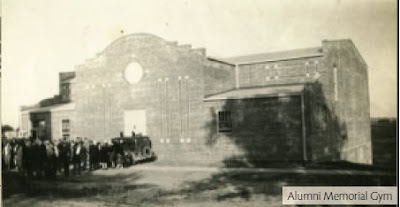
Alumni Memorial Gymnasium on the campus of Concordia College (Concordia University). The image is from The Broadcaster magazine, http://www.cune.edu/resources/docs/Broadcaster/Broadcaster_Spring_2008.pdf

Location: The southeast part of the Thom Leadership Education Center now covers the same ground.

History: Originally expected to cost $30,000 to build, the Great Depression helped knock the cost down by a third. Known more commonly as the “Old Gym” after the P.E. Building was erected in 1960, it also served as the campus post office.

Claim to fame: Home court for Concordia High School boys in 1960, the year they won the Nebraska Class C state championship. Dr. Richard Zwick (Class of 1955) remembers: “We had lots of Christmas programs in the gym on the stage, and I remember this one that everyone still remembers. The announcer came to announce the show, and it was dark to start the play, so he walked to the front of the stage and completely fell off the front of it. He did get up and continue announcing the rest, but I remember laughing so hard at that.”


Nebraska Hall

Nebraska Hall on the campus of Concordia College (Concordia University). The image is from The Broadcaster magazine, http://www.cune.edu/resources/docs/Broadcaster/Broadcaster_Spring_2008.pdf

Location: Located to the southeast of Founders Hall.

History: Nebraska Hall’s lifespan lasted from 1913 to 1986. Built for $13,200, it was primarily the campus music building and contained six pipe organs and 15 pianos in its early years. On its third floor it housed a dormitory room for 60 students. It was also was home for a time to the president’s office and the school library.

Claim to fame: Fun instead of piano practice. Dr. Richard Zwick (Class of 1955) remembers: “While I was here the upper class music students would be piano monitors, and we would go around to the practice rooms making sure the correct person who signed up for practice was practicing and everything was going correctly. Well, while I was piano monitor I would go around checking the rooms, but I would always stay a little longer at this one young girl’s practice room. I ended up marrying her later on.”


The Training School

The Training School on the campus of Concordia College (Concordia University). The image is from The Broadcaster magazine, http://www.cune.edu/resources/docs/Broadcaster/Broadcaster_Spring_2008.pdf

Location: (The white building.) Originally where Strieter and Schuelke Halls are now.

History: Built to help prepare Lutheran teachers, the Training School was used for grades 1, 2, 7 and 8. (Students in grades 3-6 were taught in classrooms in Seward’s downtown area, next to the old St. John Lutheran Church building.) The training school was used until St. John built the the first section of its current school across the street from Concordia in 1929.


Maintenance Building

The maintenance building on the campus of Concordia College (Concordia University). The image is from The Broadcaster magazine, http://www.cune.edu/resources/docs/Broadcaster/Broadcaster_Spring_2008.pdf

The Maintenance Building went up in 1952 and was taken down to make way for part of parking lot of the Thom Leadership Education Center in the late 1990s. The otherwise unremarkable building was a landmark on campus because of its tall smokestack.


The White House

The White House on the campus of Concordia College (Concordia University). The image is from The Broadcaster magazine, http://www.cune.edu/resources/docs/Broadcaster/Broadcaster_Spring_2008.pdf

White House No. 1, built in 1897, was a white frame building located to the east of Founders Hall that served as a dormitory and infirmary.

There is a very old picture of this house at this webpage. In the part marked Timeline, click on the year 1897. I would like to put that picture in this blog, but I can't download it from that webpage.

Sunday, April 19, 2009

Bicycle Mania on Campus

Paul Kolterman wrote:

I thought of something else that really sticks out in the ole memory banks -- riding bikes around campus at CTC. I always loved the sidewalks there. You would ride along and boom the sidewalk would jut at an angle a different direction. Or go in a circle or some other way. It was shady and different than riding in the street or on a regular sidewalk. Just a neat place to go ride bikes as a kid. The sidewalks were wide too, so you had plenty of room to ride.

Paul Kolterman, third-grade student at St John Elementary School in Seward, Nebraska

Out in front of Founders Hall was a mezzanine area with benches kind of a rendezvous point when riding bikes, and there were like bulletin boards there with stuff posted on them about happenings at campus. Just a neat campus.

The Endicott kids and Lukert kids and the Kolterman kids would ride bikes there because it was close for us. We would go down our alley to the north and come out on Pearl Street, shoot up Pearl street past Brandhorst’s house and then cut over to the campus. My Dad didn’t like us riding over at the College because he thought we were bothering the kids on campus.

I remember it like it was yesterday. How fortunate we were to be raised in Seward -- Nebraska’s best town.

Another thing I remember were the old bridges on 2nd and third street. The railroad used to run through there (by the baseball field at St Johns school now). We used to play around and under those bridges. Then they cleaned that all up, tore out the bridges, planted grass and made it a football field/baseball field.

My favorite memories were at the swimming pool in Moffit Park. What a hoot.

In an earlier post, my brother Steve remembered:

Bicycle hide-and-seek on the CTC campus, with the front steps of Weller being home.

I remember this activity too, and I had intended to write about it eventually. Since Paul has raised the subject so compellingly, however, I will not delay with writing my own memories too.

This was a activity that we did when the college students were away -- on summer vacation, Thanksgiving break, etc. -- and so there was little foot traffic on campus. If we had played this game during a school term, many CTC students would have been run over and killed by us small but speedy bicyclists -- thus prematurely terminating many teaching careers for the Lutheran school system and leaving some future Lutheran school children with reduced educational guidance.

And so, although the Concordia campus was created for the divine purpose of enabling us neighborhood boys to play this game -- which I call Bicycle Mania -- there was also a divine limitation that we play it only during college vacations. So, concerned parents such as Mr. Kolterman were mistaken when they worried and discouraged.

I don't think this game had a standardized name. Although Steve calls it "bicycle hide-and-seek" and Paul calls it "riding bikes around campus," I think that you might agree that the most descriptive game might be something more like:

Bicycle Mania

or even:

Bicycle War

Essentially the game consisted of about a dozen boys racing their bikes all through and around the campus like maniacs and ambushing and "shooting" at each other. Occasionally, there might be a few incidents of "playing chicken" too.

(Many of us kids were inspired by the TV show, The Rat Patrol,

Opening Credit for the TV show Rat Patrol, which ABC showed during 1966-1968. The image was taken from http://www.answers.com/topic/the-rat-patrol

which starred a team of three heroic US soldiers (and one helpful British soldier) who raced around the North African desert in a jeep, equipped with a machine gun, during World War Two and killed enemy Nazi soldiers and blew up their Panzer tanks. This TV show had practically the very same plot every week, but we boys never got tired of watching it.)

Were there teams? Was there a start or end of the game? Not that I remember. Kids came and left, and while they were there they perhaps formed temporary ambush-and-kill squads of convenience. The "game" continued for a couple of hours, and then it just ended when the last couple of guys had to go home. And even then, I think that sometimes I was the last one, and I raced around for another ten minutes just by myself.

Maybe some of you remember some rules that I have forgotten.

Friday, April 10, 2009

Steve Sylwester Remembers

My [Steve's] early Faculty Lane memories include:

Racing popsicle sticks in the street gutter during summer downpours. As I recall, the races would start in front of the brick houses and end at the bottom of the small hill at the end of Faculty Lane across from CTC gym.

Playing team Monopoly under the big tree in the backyard behind Hackmanns during the summer. Remember, the tree had a treehouse platform up in it. We played team Monopoly because more people could play that way. Eddie Hackmann always let me be his teammate until one game when I landed on a fully hoteled Boardwalk and bankrupted us. I cannot ever remember being his teammate after that (I recall Eddie shunned me for awhile after that, or at least it seemed that we to me at the time).

The CTC Homecoming celebrations. The CTC students would park a junker car in the gravel parking lot across the street from our house and sell sledge hammer whacks to raise money. The car would be painted with Homecoming slogans against the visiting team. The various dorms made Homecoming floats on the campus lawn and then included the floats in the Homecoming parade. I once was asked to carry a sandwich board through the Seward downtown area to advertise the coming Homecoming events. I remember the CTC beanies that the freshmen had to wear as an initiation. I loved Homecoming at CTC — the whole event from the run-up through the afternoon football game.

The CHS football game played at night in a blizzard. The announcer finally called out for the visiting fans to all come over to the CHS grandstands because they might be better able to stay warm if they bundled up with the home fans. The blizzard was so bad that you could not even see the visiting fans across the field when the announcer made his invitation.

Summer scavenger hunts for the Faculty Lane kids. I am not sure who organized the scavenger hunts, but I thought they were great fun.

Neighborhood plays in the Schwich's garage. I recall Danny being an enthusiastic actor.

The big apple tree behind the Mueller/Stelmachowicz brick house. I used to climb up in that tree and eat apples until I was sick. There were pear trees in the Becks' backyard, and there were rows of grapevines with grapes separating the backyards of a few houses. I think the Schwichs backyard had an apple tree, too (homebase of the backyard baseball diamond might have been under it). The Sylwesters backyard had a big garden in it, but I do not recall that any other backyards had gardens.

Bicycle hide-and-seek on the CTC campus, with the front steps of Weller being home.


I once threw up in the main room of Link Library. I had gone over to the library myself to look at books in the children's books room when I suddenly felt sick. I ran out of the room to go home and got only as far as the big room with the mural on the wall before I projectile vomited in the middle of the floor. It was a moment of supreme embarrassment.

CTC occasionally had movies in the Weller Hall chapel auditorium that we were allowed to go to. I once went to a Weller Hall movie with my brothers (and perhaps others) and we sat in the balcony. I fell asleep during the movie, and my brothers decided to not wake me when the movie was over. They just walked home to Faculty Lane. When I finally woke up, it was very late at night and I was seated alone in the balcony, and the whole chapel auditorium and all of Weller Hall was completely empty and totally dark. It was very freaky and very startling, and I was upset as I rushed home alone. Of course, my brothers thought the whole thing was very funny.

Geography

Faculty Lane ran along the north side of the core campus of Concordia College in Seward. The core campus occupied a square area that measured about 200 yards on each side. The front of the campus is Weller Hall, which faces Columbia Avenue.

There is a good map of the campus at this webpage, but I have not been able to embed it into this blog. In the meantime, we will make do with this aerial photograph:

An aerial photograph of the campus of Concordia College (Concordia University) in Seward, Nebraska. The image was taken from http://cgi.ebay.com/AERIAL-PHOTO-CD-Seward-County-Nebraska-2006-NE-Map-GIS_W0QQitemZ270366778813QQcmdZViewItemQQimsxZ20090331?IMSfp=TL0903311510002r20827#ebayphotohosting.

Columbia Avenue is the street running vertically along the left edge of the image. The large building to the right of that street is Weller Hall, and it is the front of the campus. The sides of the campus are described as follows:

* Behind the campus, on the east side, lay a football field. (About two football fields could have fit along that side.) At the north-east corner stood an athletic building that had been built only a couple years before our arrival, perhaps in about 1958.

* Along the north side of the campus stretched Faculty Lane, a row of eight large houses. In the image, the prominent street running horizontally along the top of the image is East Hillcrest Drive. Faculty Lane is a crooked street a little lower, on the left side of the image. In the image, that crooked street runs into a large building, which is the college's Music Building. The area of that Music Building previously was occupied by four houses, which were removed in 1964.

* Along the west side stretched Columbia Avenue. At the intersection of Faculty Lane and Columbia Avenue, on the Columbia Avenue side of the street, stood St. John Elementary School. If you walked south from this school along Columbia Avenue there was a row of large houses, similar to the row of houses on Faculty Lane.

* Along the south side stretched College Avenue. Across that avenue stood a row of dormitories. I imagine that those dormitories had replaced a row of houses similar to those that still (in my time) stood along Faculty Lane and Columbia Avenue.

In 1960, Concordia College was at the northeast edge of Seward. Beyond the football field lay only farm fields. Beyond the athletic field there were three or four short streets with homes, but further was open country.

An aerial photograph of Seward, Nebraska. The image was taken from http://cgi.ebay.com/AERIAL-PHOTO-CD-Seward-County-Nebraska-2006-NE-Map-GIS_W0QQitemZ270366778813QQcmdZViewItemQQimsxZ20090331?IMSfp=TL0903311510002r20827#ebayphotohosting.

In this aerial photograph, the prominent street running horizontally all the way across and just a little below the image's center is Hillcrest Drive. (You can see the football field a little below Hillcrest Drive on the image's right side.) The image shows a large residential area in the top, right part of the image, above Hillcrest Drive. In 1960, most of that area was open countryside.

If you stood at the west end of Faculty Lane, across the street from St. John’s Elementary School and then walked north, you walked into a rural area after only one block. When we arrived in 1960, the Schlueter family lived there, a block away from the school, and they raised ponies on their property. They had a large barn and a corral for the ponies.

Saturday, April 4, 2009

Place Campus

The Open Book sculpture done by Reinhold Marxhausen in 1961 on the campus of Concordia College (Concordia University) in Seward Nebraska. The photo and information were taken from http://siris-artinventories.si.edu /ipac20/ipac.jsp?session=Q239768AS4432.85380& profile=ariall&source=~!siartinventories&view=subscriptionsummary&uri= full=3100001~!319506~!2&ri=1&aspect=Keyword&menu=search&ipp=20&spp=20&staffonly=&term=%22 Marxhausen,+Reinhold%22&index=.AW&uindex=&aspect=Keyword&menu=search&ri=1&limitbox_1=Lo01+=+ias#focus

Place Campus High School

The oldest building on the campus was occupied by Concordia High School.

Kids went into the building a lot, because the basement contained a snack bar, candy vending machines, and bookstore.